

Closure Endpoints
The goal of every petroleum cleanup is a defensible closure. SPCI prepares and submits technically defensible No Further Action proposals and Site Rehabilitation Completion documentation for FDEP review. Following approval and completion of applicable well-abandonment and control requirements, FDEP may issue a Site Rehabilitation Completion Order (SRCO). We build the monitoring record, update the conceptual site model, run risk evaluations, and compile the closure package that gets contaminated sites off the active list and your liability resolved.
- No Further Action Proposals
- Confirmation Sampling
- Natural Attenuation Monitoring
- Monitoring Well Abandonment
- Risk-Based Closure Evaluation
- Closure Reporting (SRCR)
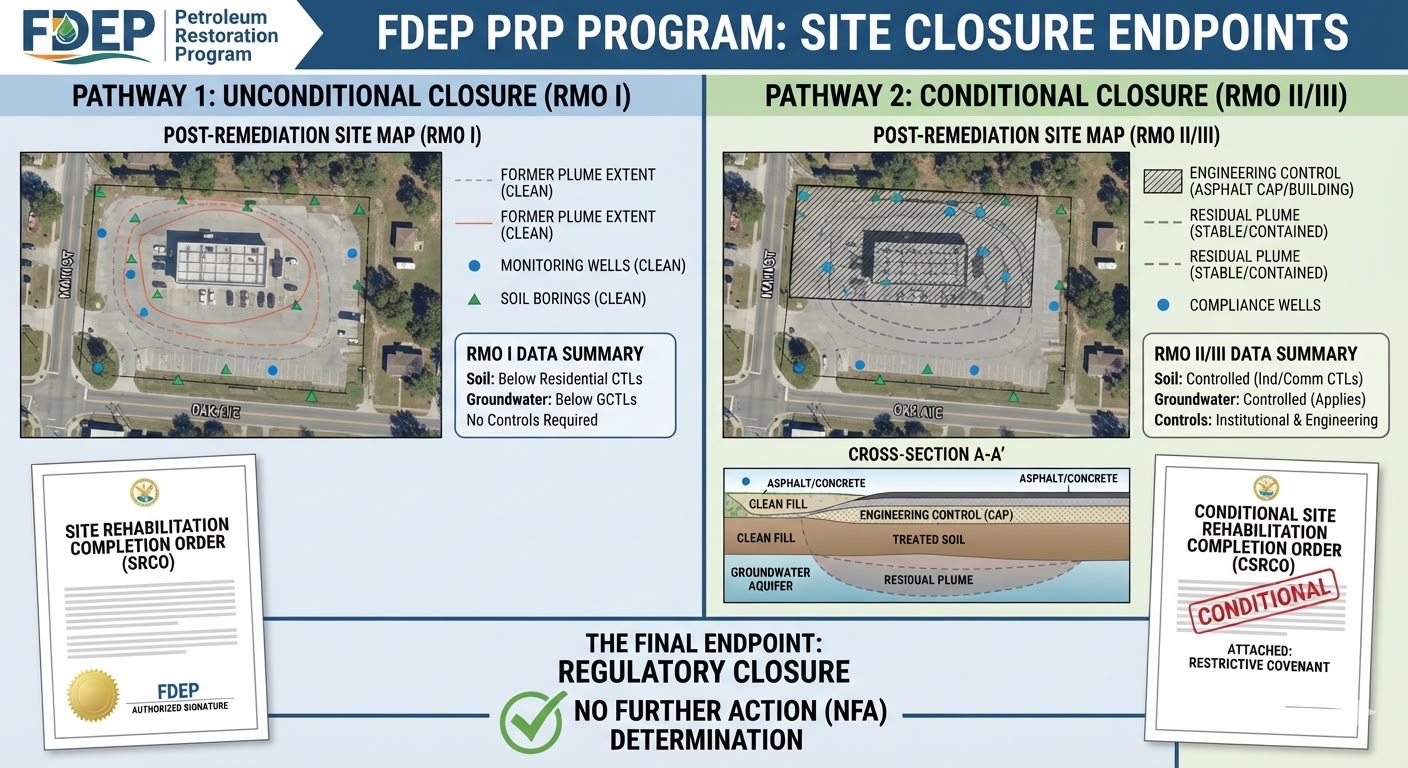
FDEP PRP Site Closure Endpoints
Two regulatory pathways lead to closure under the Petroleum Restoration Program — unconditional (RMO I) and conditional (RMO II/III) — both ending in a No Further Action determination and a Site Rehabilitation Completion Order.
Which Closure Pathway Applies?
Every petroleum-contaminated site is different. Under Chapter 62-780, F.A.C., the closure strategy depends on remaining soil and groundwater concentrations, plume behavior, free product, potential receptors and the future use of the property.
No Further Action Without Controls
RMO I is generally available when:
- Soil and groundwater meet applicable residential Cleanup Target Levels
- Soil also meets applicable leachability criteria
- No free petroleum product remains
- Surface water is not adversely affected
- Monitoring and remediation wells are properly abandoned
When these requirements are satisfied, FDEP may issue a Site Rehabilitation Completion Order without continuing land-use or groundwater restrictions.
No Further Action With Controls
RMO II may allow some contamination to remain when exposure is prevented through institutional or engineering controls. Examples may include:
- A groundwater-use restriction
- Commercial or industrial land-use restrictions
- Maintenance of asphalt, concrete or clean soil cover
- Restrictions on excavation or soil disturbance
- Recorded restrictive covenants
The selected controls must remain protective after closure and may require continued maintenance by the property owner.
Site-Specific Risk-Based Closure
RMO III may be appropriate for more complex sites requiring:
- Alternative Cleanup Target Levels
- Site-specific risk assessment
- Fate-and-transport evaluation
- Institutional or engineering controls
- Evaluation of contamination beyond the source property
- Documentation that the remaining conditions are protective
SPCI evaluates the technical and regulatory record to identify the most practical defensible closure pathway for each site.
What Must Be Demonstrated Before Closure
A successful closure recommendation must be supported by a complete and defensible technical record.
Source Control
The original release source must be removed, treated or effectively controlled so that it is no longer contributing significant contaminant mass to the soil or groundwater plume.
Free Product Evaluation
Monitoring wells are gauged to determine whether measurable free-phase petroleum remains. Free product conditions are a critical consideration when selecting the appropriate closure pathway.
Soil Compliance
Soil data are evaluated for:
- Residential or commercial direct exposure
- Leachability to groundwater
- Remaining source-zone contamination
- Potential vapor or construction-worker exposure
Groundwater Plume Stability
Groundwater monitoring data are reviewed to determine whether:
- Concentrations meet applicable cleanup criteria
- The plume is stable or shrinking
- The plume is fully delineated
- Drinking-water wells or surface waters are threatened
- Concentration rebound has occurred following system shutdown
Receptor & Exposure-Pathway Evaluation
The closure evaluation considers nearby residences, potable wells, buildings, utilities, canals, wetlands and other potential receptors.
Defensible Documentation
Closure reports may include analytical data tables, groundwater elevation maps, contaminant plume maps, concentration trend graphs, monitoring-well records, remediation performance data, confirmation sampling, risk evaluations, institutional-control documentation and professional geology or engineering certification.
FDEP’s closure guidance emphasizes evaluating free product, soil concentrations, groundwater conditions, the conceptual site model and applicable controls before recommending closure.
The Pathway to Closure
FDEP recommends evaluating the preferred closure option as early as practical, so that remedial actions are designed around the intended endpoint.
Review the Site Record
Evaluate assessment reports, remediation history, laboratory results and prior FDEP correspondence.
Update the Conceptual Site Model
Confirm the release source, geology, groundwater flow, plume limits and possible exposure pathways.
Select the Closure Strategy
Determine whether RMO I, RMO II, RMO III, Low-Scored Site Initiative closure or additional remediation is the most defensible pathway.
Complete Confirmation Monitoring
Collect the soil, groundwater, vapor or free-product data needed to demonstrate the closure endpoint.
Prepare & Submit the Closure Package
Compile the technical record, figures, trend analysis, risk evaluation and professional certifications for FDEP review.
Obtain the SRCO & Close the Site
After FDEP approval, abandon applicable wells, remove remaining equipment and complete the regulatory closeout process.
Closure
Endpoints
Closure Field Services
Our geologists and field personnel collect and document the information needed to support closure, including:
- Monitoring-well gauging
- Depth-to-water measurements
- Groundwater elevation calculations
- Free-product thickness measurements
- Low-flow groundwater sampling
- Field-parameter stabilization
- Photoionization detector screening
- Soil and groundwater confirmation sampling
- Plume-perimeter monitoring
- Source-area and downgradient sampling
- Natural attenuation monitoring
- Post-active-remediation monitoring
- Concentration trend evaluation
- Well abandonment documentation
- Chain-of-custody and QA/QC records
Is Your Petroleum Site Approaching Closure?
Your site may be ready for a formal closure evaluation when:
- Active remediation has reached diminishing returns.
- Contaminant concentrations are consistently declining.
- The groundwater plume is stable or shrinking.
- No measurable free product remains.
- Source-area concentrations have been substantially reduced.
- Perimeter wells are compliant.
- Post-shutdown monitoring shows little or no rebound.
- No potable wells, buildings or surface waters are threatened.
- Remaining impacts may be managed through an approved risk-based closure strategy.
- FDEP has requested closure sampling, a closure report or a risk evaluation.
A closure review can identify whether additional remediation is necessary, or whether the existing record already supports a No Further Action proposal.
Closure Documents & Deliverables
Depending on the site and selected closure pathway, SPCI may prepare:
- Closure strategy memorandum
- Updated Conceptual Site Model
- Groundwater monitoring report
- Post-Active Remediation Monitoring report
- Natural Attenuation Monitoring report
- Confirmation sampling report
- Risk-based closure evaluation
- Alternative Cleanup Target Level support
- No Further Action proposal
- Site Rehabilitation Completion Report
- Institutional-control documentation
- Restrictive covenant exhibits
- Monitoring-well abandonment report
- FDEP response-to-comments
- Regulatory coordination
Closure With Institutional or Engineering Controls
Some properties may qualify for closure even when contamination remains above unrestricted-use criteria. In those situations, FDEP may require controls such as:
- Groundwater-use restrictions
- Land-use restrictions
- Recorded restrictive covenants
- Asphalt or concrete cover
- Clean soil cover
- Excavation restrictions
- Engineering-control inspection and maintenance
- Institutional Control Registry documentation
SPCI evaluates whether conditional closure provides a practical alternative to extended remediation, and coordinates the technical documentation needed to support the selected controls.
Why Use SPCI?
Find Out Whether Your Site Is Ready for Closure
Have years of monitoring data, an inactive remediation system or a plume that appears stable? SPCI can review the technical record and identify the most practical path toward an FDEP Site Rehabilitation Completion Order.
Request a Closure-Readiness Review Send Us Your Site ReportsServing petroleum-contaminated properties throughout Florida under the Petroleum Restoration Program.
Closure Questions
Does all contamination have to be removed before a site can close?
No. Unconditional closure (RMO I) requires concentrations to meet applicable Cleanup Target Levels, but RMO II and RMO III allow contamination to remain when exposure is prevented through institutional or engineering controls, or when a site-specific risk evaluation shows remaining conditions are protective.
What is the difference between an NFA proposal and an SRCO?
The consultant prepares and submits the No Further Action proposal or closure recommendation. The Site Rehabilitation Completion Order is what FDEP issues after reviewing and approving that package and confirming well-abandonment and control requirements are met.
My remediation system has been shut off for years. Can the site be closed?
Often, yes. Post-shutdown monitoring that shows stable or declining concentrations with little or no rebound is exactly the evidence a closure evaluation needs. In many cases the existing record already supports a closure proposal without further active remediation.
What happens to the monitoring wells after closure?
Monitoring and remediation wells must be properly grouted and abandoned to FDEP standards, and the abandonment documented. Remaining remediation equipment is removed as part of the regulatory closeout.
Does conditional closure create ongoing obligations for the owner?
It can. Controls such as a recorded restrictive covenant, a groundwater-use restriction or a maintained asphalt or clean soil cover must remain protective after closure, and engineering controls may require periodic inspection and maintenance by the property owner.
Who pays for closure work?
Eligible sites may have closure activities funded through the State-funded Petroleum Restoration Program. See our PRP Funding & Eligibility page, or contact us for an eligibility review.
Southeastern Petroleum Contractors, Inc. © 2025
Powered By
Lakeland Marketing Pros